Wednesday, March 6, 2013

Kelly's TBP 1.13: Alexander McQueen: Savage Beauty

Dear Jenny,

No, I have not forgotten my TBP list! I've just gotten behind on write-ups, due to unpacking the house. Have I mentioned the unpacking? The soul-sucking, seemingly-never-ending, unpacking? Ugh. My goal is to be done by the end of March. Wish me luck!

Now, onto my first TBP book of 2013... Alexander McQueen: Savage Beauty. A stunning book about a fantastic exhibit featuring an amazing designer. Really, so beautiful. (And I'm not afraid to use all of those adjectives to describe it!)

I went to see this exhibit with a friend in a whirlwind overnight trip in 2011. We took the red-eye from SF to NYC and went straight to the Met (okay -- I think we showered at the hotel first. But then headed straight out). It was over 100 degrees that day which, in New York City is just... horrendous. Especially for CA wusses like us (I still can't handle the heat yet -- maybe a few more years?) But oh, it was still amazing. It's New York!

Here's a shot I took as we waited on the front steps of the Met:

There was an absolutely enormous crowd -- it was a weekday and the entire city was melting, but so many people wanted to see this exhibit there was a crowd gathering before the doors even opened!

The exhibit itself was spectacular, but definitely crammed body to body. Despite that, I was able to get close to most of the garments and accessories so I could really see them, which was... truly amazing. To see the stitching of these garments up close? WOW. Such a huge inspiration. Just... really powerful.

In the gift shop, we saw this book. We knew we had to have it because it was awesome photos of the pieces we had just seen... without the crushing press of bodies! But it weighed a royal ton and all we had were overnight bags. It's a gigantic hardcover book.

So I used technology to my advantage and ordered us each a copy on Amazon while standing right there in the gift shop. They were delivered the day after we returned and we didn't have to lug them back. Score!  [Side note: Sorry, Met, for screwing you on the sale -- maybe you need a kiosk in the store where people can buy from you and ship stuff straight home to themselves? Just an idea. I would have paid full price. It really was the weight that did me in.]

But... onto to the book! It's very well done -- a bit of expository information on the life of Alexander McQueen (such a tragedy -- the world lost an amazing talent when that guy decided to go) and then 200 pages of gorgeous photos, interspersed with quotes from the artist himself. I'm glad I waited to look at this book until now -- it brought it the entire exhibit back to me as I perused it. And without any the elbows to the kidney!

Sooo.... would you like to see some of it? Of course you would!

First of all, the photo on the front is like those wacky stickers we had as kids -- angle it one way, you see the skull, and the other, it's McQueen's face. I don't know what that's called... Oh, thanks, Internet! You're the best! It's called lenticular printing. (Now we've all learned something!)

Kind of gimmicky, but it's pretty danged cool:

(That photo of it is not great, but it gives you the idea.)

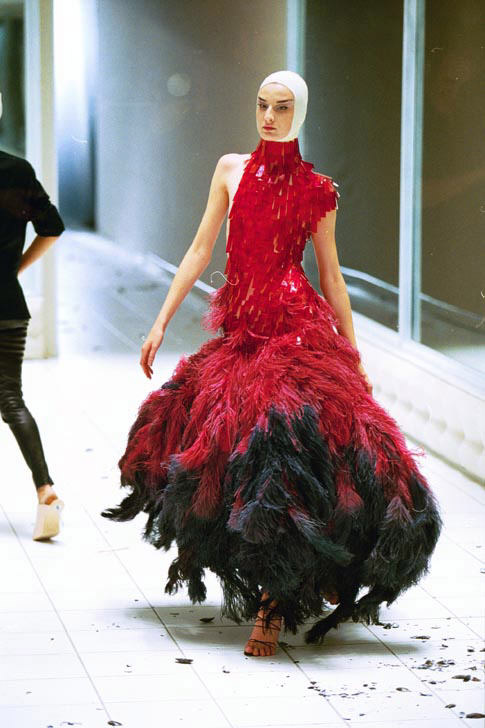
Now let's get to the pictures! This first dress was fucking amazing in person. Those red pieces on the bodice are all glass slides. Like, microscope slides? I mean... seriously.

(I wish there was a photo of the front of this dress in the book -- again, all glass microscope slides. Crazy.) (Oh, look! There's a better photo of it here. A-maz-ing!)

This next dress is made from real flowers. Quote from McQueen: "Remember Sam Taylor-Wood's dying fruit? Things rot… I used flowers because they die. My mood was darkly romantic at the time." [183]


At the exhibit, there were dead flowers that had fallen off of the dress scattered on the ground all around it. While we were standing there looking at it, some of the petals actually fell off. Right then and there. Whoa! We saw it decomposing As. We. Stood. There! Mind-blowing. (You can see some dead flowers on the ground around it in the photo... not sure how much longer this one's got.)

(Oh, and I didn't know who Sam Taylor-Wood was, so I looked it up and vaguely do remember this video now -- 3+ min of film of a bowl of fruit as it rots.)

Moving on... this was just one of my very favorite dresses -- the swirls on the sleeves are sparkly. I love that so much.


Here's another dress that I loved. It's just... the perfect princess dress:


About that particular collection, McQueen said:

When I design, I try to sell an image of a woman that I have in [my] mind, a concept that changes dramatically each season. 
[In this collection] she was a feral creature living in the tree. When she decided to descend to earth, she transformed into a princess. 
I don’t really get inspired [by specific women]. . . . It’s more in the minds of the women in the past, like Catherine the Great, or Marie Antoinette. People who were doomed. Joan of Arc or Colette. Iconic women. [115]
And here is one that shows off his meticulous attention to detail (which was even more evident in person)... look at the cut of this jacket and dress! Just mind blowing:

(Yeah. I realize that the print is basically a magnifier for her hoo-hoo, which is barely covered, but I'm just looking at the technical aspects of it. Impeccable construction.)

One of the most mesmerizing pieces in the exhibit was a set of carved wooden prosthetic legs that a model wore at one of McQueen's shows. People think they are boots, but, no -- they are motherfucking legs, ya'll.

I am glad to have this photo, but this was even more jaw-dropping in person:


Aaaand... here's a cray-cray shoe:


This final image is a lovely double-page spread and was used for the exhibit's poster. Seeing this now, I would have liked it if they had shot more of these pieces as "action shots," thereby differentiating the images in the book from what we saw at the exhibit.

(That photo is crap -- for a better version of it, plus all kinds of cool other things to see about McQueen and the exhibit, go here and check it all out.)

Soo... I guess that final comment is my only real problem with this book -- maybe more action shots, so you could really get the idea of how the pieces looked with movement (and many, like the glass slide dress, only showed the back or the front -- both sides, please!)

But, overall, an incredible complement to an amazing exhibit that also stands alone as a catalog of a beautiful body of work. (This post was brought to you by a surfeit of adjectives -- I just can't help myself when faced with the greatness of Alexander McQueen!)

love,
kelly

Tournament of Books: Jenny's Reads

Kelly,

It's the most wonderful time of the year! Seriously. I live for this. I don't know what that says about me, but combining competition and book reading?! What's not to love?

Like you I'll do a quick recap and make some predictions. I love hearing about the audiobooks (aBooks?)!


The Play-In Round
I'm in process on Billy Lynn, but I'm no fan. It's well written and sly in a way that's generally appealing to me, so I have to figure out why this one is annoying me so much instead. I'm going to finish it this weekend. That being said, it was better than both The Yellow Birds and Fobbit. I actually sort of liked The Yellow Birds, but it had all the earmarks of a first novel: the overwrought language and the plot that never quite comes together. Fobbit seemed to be going for more of a Catch-22 vibe (a book I loved in high school and should reread) by capturing the folly of war. It just didn't work for me. There were some funny parts, but it seemed strained. I wouldn't have finished it if it wasn't in the TOB.

Round House vs Fault in our Stars
I think Round House should win this one. I loved them both, I did, but The Round House has a certain kind of gravitas on its side, I think. They're well matched in terms of plot: teenage protagonist(s) dealing with tragedy. But I do honestly this one could go either way and I would be fine with it. I should scan the last few pages of the Round House and send them to you. I just let a friend borrow it, but I bet we have a copy in the library. As for Fault, I didn't love the trip, but I didn't hate it either. Overall, I thought the conversations about life and death were beautifully done. I haven't read many adult books that have dealt so honestly or heartbreakingly with death. I don't want to spoil it here, but next time we talk, let's make time for this one.

Orphan Master vs. Bernadette
Sometimes I feel like I can figure out why things were paired together, but this is a mystery. Maybe unconventional narrative structure? Bernadette's correspondence, Orphan Master's broadcasts? I loved Bernadette, but I don't see it beating Orphan Master here. It's such a great book. It really was the whole package: interesting location, fascinating and fully formed characters, interesting and complex plot, good ending. I think it could to all the way.

Dear Life vs. Building Stories
I actually liked Dear Life more than I thought I would. I tried reading Alice Munroe in college and just didn't get it. But she writes about grown ups, I don't know how else to say it, and I probably just didn't have the life experience or the patience for her 20 years ago. I do feel it was a real accomplishment for me that I read that, because I had always felt intimidated by Munro. I'd still like to see Building Stories win here, though. It is certainly a more interesting non-novel than Dear Life...if that makes sense. It was so sad and melancholy! I loved it. Except for the Bee. I still regret ending on the Bee book.

May We Be Forgiven vs. Billy Lynn
I'm halfway through both and have a week to finish them. But there's nothing standing in my way now!

Gone Girl vs. Ivyland
I'm sorry, but you'd have to be brain dead to pick Ivyland over Gone Girl. I read pages and pages of Ivyland and it literally made no sense to me. I'd read entire chapters having no idea what was going on. I wonder how it got in the TOB, sure. But I also wonder how it even got published in the first place. I might be missing something, but I don't care. Life's too short for crap like that.

Beautiful Ruins vs. Song of Achilles
You've read one and I've read the other. Song of Achilles just wasn't my speed. I'm quite familiar with the story of the Trojan War, so right from the beginning, I was wondering how the author was going to carry it off. Carry what off? you may be wondering. Well, Patroclus is the narrator. And I know damn well that he dies at Troy. His death drives Achilles mad and causes him to not only kill Hector, but also to desecrate his body. The book is a rather touching love story between Patroclus and Achilles: in this version they meet as boys and become lovers. But I found the lush narrative style to be a bit cloying. At one point, Patroclus describes finding mushrooms "as delicate as the ear of a baby." Oh, hell no. Not to mention the fact that you've really painted yourself into a corner with a dead narrator. I didn't hate it, but I didn't love it either. Honestly, it was a romance novel. I like romance novels. And I've certainly read better romance novels.

Bring Up the Bodies vs. HHhH
Am I the only one who thinks its weird having a sequel in the TOB? I can't imagine you could read it cold. But this also seems like an obvious pairing of historical books up against each other. You'd think Bring up the Bodies would be a lock here, but they are very different. HHhH is meta fiction, and if you like that sort of thing, it could be the winner. I don't know why I can't make myself read Bring up the Bodies---I think because I know how difficult it was to read Wolf Hall. Unlike most people, I tend to do my heavy reading in the summer. I just have so much more time and energy to devote to my reading then. Maybe I can get to it on my upcoming Spring Break.

Arcadia vs How Should a Person Be?
I liked the story of Arcadia. I hated that it didn't have quotation marks. I have yet to meet someone who has liked HSAPB?, but you never know. Arcadia is beautifully written. I don't really have a dog in this fight. I didn't like Arcadia enough to root for it.

Prediction
I did fill out some brackets. I guess I'd say that The Orphan Master's Son has the best chance to win it. It's a great book. But I'd be okay if Gone Girl or The Round House took the Rooster.

Jenny

Monday, March 4, 2013

Kelly's Book 3.13: Why I'm Like This

Dear Jenny,

For the life of me, I cannot remember how this book came into my hands. Maybe a long-ago bookstore browsing session? Well, it's been on my shelf for awhile and it is now time to read it.

I had big plans to star 1Q84 with my extra time in February, but I ended up getting distracted by a few other books, plus unpacking our house (which makes for great aBook time!) so now I'm going the opposite way and choosing a book that looks short n' easy, since I am still working on HHhH and would like to finish it in time for the ToB matchup on March 15.

Just flipped to the Author's Note and have already laughed out loud...

Author's Note: I have changed the names of some people and some places because my editor made me.

HA!

love,
kelly

Tournament of Books: Kelly's Reads

Dear Jenny,

Well, today is the day! I know you're excited about the Tournament of Books! BUT... I also know that you are in the midst of grade reports, so come back here when you are done with those to read my long-winded chitter chatter. :)

This year has, by far, been my biggest participation in reading the ToB books. Most years, I sit back and wait to see what rises to the top and then add those books to my own TBR pile, but this year I have read almost half of the books! It started with the fact that I had happened to listen to two of the books, and then some of the others started coming to light as great audiobooks. I'm always looking for a good aBook, so I ended up jumping on quite a few.

So I thought I'd jot down my thoughts on 'em. (And maybe a little ToB prediction talk... I'm a wild woman!)

Unless otherwise noted, I listened to the audiobook of all of these, so my comments are about both the books and the performances...

Completed

The Round House by Louise Erdrich
I know you hated the lack of quotation marks, so I avoided that problem entirely by listening to it! However, there were a few times in the book where things *did* get confusing without a clear deliniation of who said what and I think even the narrator got confused (since he didn't really change up the voices in those parts). Those scenes were usually ones where young Joe was eavesdropping on adults' conversations and I wonder if the intent of the no quotation marks was to illustrate the fact that he didn't fully understand what was going on? (So, you know, neither should the reader? Ugh.) Sorry -- don't mean to beat this dead horse... move along.

Overall: I really loved this book, except for... well, I already sent you the question I had at the end and I have now listened to it *four* times and still cannot really put my finger on my confusion -- there is a lot of descriptive language in this book, and it is mostly well-delivered by the narrator, but that final scene falls apart for me. Maybe next time I see the pBook version of this book, I'll flip to the end and read through it and see if it's more clear to me what happens there [this was intentionally cryptic... I generally don't care about giving stuff away, but since you're so active on the ToB site, we may get some traffic this way and they may not know: We're spoiler-y!]

I guess that's one drawback of the aBook: It can be difficult to "re-read" passages -- especially when there is any confusion.

Gone Girl by Gillian Flynn
I was reluctant to read this book because everyone kept saying how despicable these characters were and I wasn't sure if I could deal with characters I hated for a prolonged period of time. However, the narrators had such great voices... I think I might have liked the characters better than they were written, because I liked the narrators so much.

Of course, that's also due to the writing... as much as I hear about how terrible these two are, I also have heard them described many times as "sympathetic." So I guess it's a combo of writing + performing. And it's a winning combo at that -- this was a great aBook. I actually said "Holy shit!" out loud when the twist happened. So... a) good twist and b) good job for me of remaining spoiler-free. Heh. I didn't want to put this one down.

The Fault in Our Stars by John Green
Well, sure... of course I loved this book. And, for this one, I'm glad I was 100% spoiled so that I could brace myself. I'm curious what you and others think of the trip -- it's really the only unrealistic part of the book, but I liked it anyway... and the description of the petals on the water really moved me.

One nice thing about this aBook was an interview with the author at the end, discussing the performance and how great he thought it was. I really enjoyed hearing his thoughts on the book, the characters, and the narrator.

The Orphan Master’s Son by Adam Johnson
How were the loudspeaker moments shown in the book?! In the aBook, there was a separate narrator with a BIG BOOMING VOICE doing the loudspeaker announcements, which made me wonder how it was done in writing. Overall, this book had stellar narration (different actors for the two main characters) and a totally engrossing story, so a grand slam. And it made me *super* curious about what the heck is going on in North Korea!

Where’d You Go Bernadette by Maria Semple
As soon as I started listening to this little Hate Letter to Seattle, I said, "Jenny has got to read this." I thought it was a fun read -- the narrator for this book did a great job with Bernadette's voice, as well as her daughter's.  I'm a little surprised it's in the ToB because it's kind of "fluff" to me, compared to most of the others, but it's nice to have variety.

Beautiful Ruins by Jess Walter
This book was slow to get going -- I thought I might even have to bail on it. But I stuck with it, and it got so much better. I loved the interweaving of these stories and I really cared so much about how everything turned out for each of the characters.

Building Stories by Chris Ware (pBook)
LOVED this. Great story, great drawings (except... the cats' tails seem weird -- they look more like dog tails. It's a minor nit, but a little distracting.) I've read a lot of graphic novels and one thing that this format made me do is really slooow down. It's often a little too easy to eat graphic novels up like ice cream, but this one really made the reader dig in, and I loved it for that.

In progress:

May We Be Forgiven by A.M. Homes
So far, I like this book SO MUCH MORE than I thought I would! Of course, it may, like any other book, turn to shit before I'm done and I could end up hating it, but so far, I am really engaged. Part of it, I suspect, is that same thing that made the Gone Girl characters more appealing -- the narrator is really good. If I had read this book myself, I'm not sure I could have stood this main character. But I like this actor -- he makes an unsympathetic character sympathetic (which, as I said with GG, can also be attributed to good writing... but reading other people's reviews of this book, I'm not so sure...)

HHhH by Laurent Binet (eBook)
I know you loved this one, but I am really struggling to get through it. Every time I start reading, my mind wanders and I suddenly realize I have not been paying attention for the past few pages. The parts that engage me the most are when the author/narrator is speaking directly to the reader, but when it's a straight-up (or not -- we'll never know!) history lesson, my mind wanders. I know that you know a lot about this topic already, so maybe it's easier for you to skim those parts? I don't know a ton about history, so a lot of this information is new to me and the delivery of the historical facts kind of bores me (at least, I guess I'm bored... my mind wanders...) (OMG! How can you be BFFs with such a troglodyte? ;) But I'll stick with it. I had a pretty good run yesterday night.

On the Maybe pile:

Arcadia by Lauren Groff
I keep going back to this book -- the premise looks so great, but then I've read a lot of disappointment about it. Maybe I'll see how it fares in the ToB and decide then.

Bring Up the Bodies by Hilary Mantel
Well, I haven't read Wolf Hall and I'd like to, so I won't read this until/unless I've read that one first. So... maybe someday.

Not at all interested:

How Should a Person Be? by Sheila Heti
From the reviews, this book sounds unbearable and, from the description, it reminds me of pretentious a-holes I knew in college, so... pass.

Ivyland by Miles Klee
I have yet to read one good review of this book by anyone whose opinion I respect.

Dear Life by Alice Munro
Eh. Some people really like this author, but I haven't read any of her work and people who *do* like her keep saying, "This isn't her best." So, unless I suddenly decide to get hooked on Munro and have to read every one of her works, I don't see this hitting my bookshelf.

The Song of Achilles by Madeline Miller
This seems like a re-hash. Do we need another re-telling of this story? (Correct me if I'm wrong here... I may be!)

Aaand... the war books that were vying for the final slot:
Fobbit by David Abrams
Billy Lynn’s Long Halftime Walk by Ben Fountain
The Yellow Birds by Kevin Powers

Well, I don't really do war books. Billy Lynn has made it to the final 16 and... yeah. Not that interesting to me. I've read your comments about it on GoodReads, so unless you finish it and tell me it got better, this one is also off the radar.

Random thoughts on ToB matchups :

(Really only speaking to books I've read...)

I would hate to have to choose between The Fault in our Stars and The Round House!

Where's You Go Bernadette seems like too much fluff to stand against The Orphan Master's Son in the first round. I think they missed a great opportunity in not matching up Bernadette with Gone Girl -- I mean... "Where'd You Go, Amy?" Am I right?

Plus...it just seems like Gone Girl will smoke Ivyland -- the matchup seems unfair. One of the biggest books of 2012 vs. this totally unheard-of (when the ToB was first announced, it had 2 reviews on Amazon. It now has 3.) book? I mean, I guess maybe it will be the "Big! Upset!" of the tourney, but... hrm.

Beautiful Ruins is another book I think of as somewhat "fluffy" and it's up against the Song of Achilles, which is not. But I feel like BR is original and SoA is a re-hash, so it could go either way.

I hope, hope, hope Building Stories will move on to the second round, just because I love it so much, but I can't really speak to its chances, since I did not read Dear Life.

And now... I will go tune into the ToB and see what folks there are saying... see ya there!

love,
kelly

Saturday, February 9, 2013

Completed: The Swerve, How the World Became Modern

Kelly,

This was a very enjoyable read, but after I finish writing this review, I'm going to hit the internet, because I can just guess that it's one of those historical books that some people vehemently disagree with.

The Swerve is a short work of history (the text runs only about 250 pages, followed by over a hundred pages of endnotes) by Stephen Greenblatt. The Swerve won both the National Book Award and the Pulitzer for non-fiction. It tells the story of how an Italian book hunter Poggio Bracciolini rediscovers an ancient Roman manuscript in 1417. This work was called On the Nature of Things, by the poet Lucretius. Greenblatt's thesis is pretty straightforward: the revolutionary ideas contained in Lucretius's poem would spread through Europe like a contagion, eventually sparking some of the greatest minds in history towards the Renaissance.

Anyone who loves books would find this to be a fascinating read. Much of the first half of the book describes the state of reading throughout history: the change from scroll to book, the destruction of the great library at Alexandria, the discovery of ancient scrolls in Herculaneum, the process by which monks copied and preserved (or sometimes destroyed) ancient manuscripts. Honestly, there's more interesting stuff in here then I could possibly even describe. I loved the author's writing style. He is able to create such a dramatic interesting story, seamlessly weaving together stories of ancient Rome and fifteenth century Italy.

This book actually reminded me of a class I took my senior year of college. (You may remember me talking about this class, because the professor was a guy named Father Flynn--a visiting professor from Emory!) That class was a philosophy class, but Father Flynn was probably the best lecturer I have ever had the pleasure to listen to. The breadth and depth of his knowledge was incredible, and he wove all sorts of interesting stories into his lectures. It was so fun to just sit there and soak up ideas about knowledge and ideas about how the world worked.

This book struck that same chord in me. Just watching Greenblatt put together the story, adding fascinating tidbits and pieces of knowledge was so fun. Poggio, our bookhunter, was the right hand man to Badlassare Cossa, also known as Pope John XXIII. This is during the Western Schism, which I **vaguely** remember learning about in high school religion classes. In high school, this all seemed extremely boring, which is too bad, because this book makes it sound pretty interesting. Cossa and his retinue arrive in Constance, Germany, along with hundreds of thousands of other churchmen, royalty, and his rivals for the papacy. Here is Greenblatt's description of Cossa's arrival at Constance: With his power rapidly melting away he took care to insist on his prestige. If he could hardly claim any moral high ground, he could at least establish his ceremonial significance...Clad in white vestments and a white miter, on October 28, 1414, Baldassare Cossa made his entry into Constance on a white horse. Four burghers of the town carried a golden canopy over his head. Two counts, one Roman and the other German, walked by his side, holding his bridle. Behind them rode a man on a great horse from whose saddle rose a long staff bearing a huge umbrella..made of red and gold cloth. The umbrella, broad enough to spread over three horses, was topped by a golden knob on which stood a golden angel holding a cross. Behind the umbrella came nine cardinals on horseback, all in long, red mantles, with red hoods, and all wearing red hats...And at the front of the procession stretched a line of nine white horses, covered with red saddlecloths. Eight of these were laden with garments---the pope's wardrobe was evidence of his hold upon his sacred identity---and the ninth, a little bell jingling on its head, bore on its back a casket of silvergilt covered with red cloth to which were attached two silver candlesticks with burning candles. Within the casket, at once jewel box and tomb, was the Holy Sacrament, the blood and body of Christ. John XXIII had arrived (165).

If only they had made history so interesting in high school! (Not like you haven't heard that before.) I loved the vivid description of Casso's pageantry. Imagine how impressive that would have been if you were just a poor peasant living in the Alps. The Swerve is filled with fascinating stories like this, and because so much of this book was related to books, education, and ideas, it was so much fun to read.

So, that's all the good stuff. But there's something weird about this book, too. Greenblatt tells a fascinating story in the first two thirds of the book about Poggio and how books were preserved and rediscovered. Only in Chapter Eight, at page 182, does Greenblatt start to describe Lucretius' poem. The rest of the book does a pretty good job of describing the ideas in the poem and they were seen as heretical, and threatening to the Church and good Christians everywhere. It's fascinating, mostly because he correctly anticipates so much scientific discovery. A big part of his poem is about the nature of matter, and that all things are composed of tiny, invisible particles called atoms. You might be wondering why such a simple idea was threatening to the Church. Well, as it turns out, it directly contradicts the doctrine of transubstantiation. You can't exactly claim that the communion wafer *is* the body of Christ at the same time that you accept that everything in the Universe is also made of tiny particles. In fact, in the 1980s, the Vatican uncovered evidence that part of the reason Galileo was treated so harshly at the Inquisition was because of his belief in atoms, not just his contention that the Earth went around the Sun.

Believing in atoms was not Lucretius' most outlandish idea. Although many said that Lucretius was an atheist, the text of the poem shows his beliefs are even more threatening to the power of the Church. On the Nature of Things states that there are gods, but our petty human concerns mean nothing to them and that the Universe was not created for the benefit of humanity. Lucretius argues that the Soul is part of its human body, and when that body dies, the Soul does as well. There is no reward or punishment after death, because bodies are made of atoms. Once someone dies, their life is over and there is nothing after. Therefore, the highest goal for a human should be to reduce pain and pursue pleasure. The Church is nothing but a superstitious delusion trying to control us and keep us from pursuing pleasure. His poem argues that the Church makes its cruelty evident in its most powerful symbol, that of a parent sacrificing a child.

The book goes on to argue that Lucretius' ideas influence a huge number of important writers, poets, artists, and philosophers---everyone from Shakespeare to Isaac Newton. My guess is that this idea, that the discovery of On the Nature of Things by Poggio in 1417 was the underpinning of the entire Renaissance is just a bit too broad to swallow. It just seems like such a huge claim, and although he produces some interesting ideas, that part of the book just never seems totally convincing. In fact, he isn't even able to fully demonstrate that Poggio even read the text. He actually orders a copy made, gives it to a friend, and then doesn't even see it in person for a decade. It's strange to make such a strong case for "Ohmigod! Finding this book changed the world!" when the guy who found it seemed so disinterested in reading it. It's more than a bit anticlimactic.

Greenblatt also wrote Will in the World, what I'd call a speculative biography of Shakespeare. This is a guy that seems comfortable with a fair amount of guesswork, and my guess is that there are plenty of scholars who will say it's a reach. But for a general reader, I'm not sure if I should care. Even without completely buying the premise, the book still told a richly interesting story. I felt the same way about Will in the World. It's a pleasure to have someone tell a historical story in a way that comes alive, to have an author so confident in his knowledge that he's willing to speculate a little about how things might have unfolded. (Especially when the historical record is so thin. People playing fast and loose with history when there's plenty of data is just annoying. I am going to be disappointed if this guy is playing *really* fast and loose, which I suppose is possible.) I enjoyed it immensely and definitely recommend it.

Jenny


Monday, February 4, 2013

Completed: 13, rue Thérèse

Dear Jenny,

Well, this was a fun little read. A bit like Griffin and Sabine, but less magic (both in the story line, as well as the "artifacts," which, in G&S can actually be handled but in this book, they're just photos), a little like The Venetian's Wife in that you are delving into the past and it feels like a puzzle.

Plot Summary:
An academic in Paris finds a mysterious box of artifacts in a drawer in his office, hidden there by his assistant for him to find. In it are remnants of a woman's life who had lived in the earlier part of the 20th century at 13, rue Thérèse. He ends up getting sucked into her story and, in some parts, actually getting sucked back in time and interacting with her.

It's an interestingly told story about her life in the past and his life in the present. There isn't a lot of connection between their two lives, but the stories still feel intertwined... perhaps because of the artifacts: Things that she has held in her hand, he holds now. Then he hooks up with the assistant who hid the box, which might have been her intent all along. That story is a little extraneous, but it's fine, because the whole thing is all a little odd. So more oddness works here.

About 1/4 of the way through, I thought, "I have no idea what is going on in this book and I might have to re-read it..." but then things started to gel and come together. It got all weird and mysterious but then had a pretty satisfying conclusion. Sometimes I find these magical time-transcending artifact-laden stories either end on a WTF note (or on a WTF image — see meat lap) or a sort of cliffhanger/mystery trail-off (indicating, to me, that the author actually said "WTF?" to themselves when they got there and just ended it) but this book did wrap up quite nicely, while still leaving a bit of mystery.

A cool idea that didn't quite work out:
Sooo... this book delved into the "multimedia" and it didn't really work for me. The concept: Use your phone's QR reader to view the artifacts in more detail. Unfortunately, a lot of the artifacts also have audio content in embedded Flash which means, if you have a Very Popular Smartphone (hint: begins with an "i"), you cannot hear the audio. Fail. Sooooo... I took the time to go to a computer to find out what I was missing. Turns out that it was audioclips of someone reading the text. Which is... a little odd. I guess the parts in French would be cool — listening to someone actually speak French is a bit of an immersion, right? But... it's not worth stopping reading, going to my computer, and going to the site. It's kind of disruptive.

And the site itself is lovely, but flawed... all of the stuff is out of order, so it's not like it's easy to say, "Oh, yeah — I've read pages 25-50 today, lemme catch up on checking out those artifacts." You can see the site for yourself right here. I honestly cannot imagine why they put that crap all out of order except... they wanted you to have that "treasure hunt" feeling? Or they didn't want someone who has not bought the book to just skim through the stuff and get the book "for free?" So strange. If they're all that hyped about that, they could have made the site password protected and then given people a password in the book. At least you'd have to actually look in the book to get the password. I don't know. I'm just spitballing here. For those of us who *do* own the book and want to check this stuff out, it's just kind of a hassle.

Sometimes the artifact is accompanied by audio and sometimes there is a clip from the text... For instance, this one just has the copy straight from the book. I actually didn't look at them all because, as I mentioned, it was kind of tough to sift through the stuff. I didn't really find any "easter eggs" or anything — just larger pictures of the artifacts, plus clips of the text, either written or voiced. This one had a video attached to it at some point, but now it's no longer available. It seems like a neat idea, poorly executed.

TMAI (Too Much Author Info):
Sometimes, learning more about an author's story makes a book more interesting. Sometimes, a little less. Unfortunately, the latter is the case with this one (but you never know until after you've gotten the author details, right?)

As it turns out, the box of artifacts is real and the author actually lived at 13, rue Thérèse as a child. According to the site, when the woman upstairs died, she left this box and no one ever claimed it. The author has been carrying it around with her ever since, planning to write this book all along (she moved to the US in the 1980s at the age of 13).

So even though the main character, Louise Brunet, did exist and these were her possessions, the entire story about her was manufactured by the author. She knew nothing about this woman and made up everything from these artifacts, which included photos of her life, a glove, sewing notions, a few coins, etc. I think it would have been more interesting if she had managed to research this woman and actually write a real history about her *or* just used the artifacts to tell a work of complete fiction.

As it stands, it sort of rubs me the wrong way — I hope someone doesn't find a box of my crap when I'm dead and make up an entire book of stories about me, using my real name, address, and photos... especially one that involves me cheating on my husband with a neighbor!

The Curse
Aw, man. I really did like this book, but 2/3 of this write up is about stuff I didn't like! I guess it really is true that it's easier to bitch and moan than it is to say positive things. Oh, well. I'm leaving it — it's our blog and I can bitch and moan if I want to. ;)

love,
kelly

PS — Just remembered that you asked me how my French was on that last post. Um... rusty? There was quite a bit of French in this book (with translations) and I was able to read some of it, but not much. I'm slightly better conversationally, but still... rusty.

Wednesday, January 30, 2013

Kelly's Book 2.13: 13, rue Thérèse

Dear Jenny,

I know it's not quite February, but I'm dying to dive into this book, so I'm going to. I bought it at a recommendation from my mom's friend Susan, an avid reader whose opinions on books I respect.

I bought it at my favorite bookstore in the world (Powell's, of course). I knew I had to buy the pBook because there are a bunch of artifacts depicted throughout and the eBook still can't quite handle that -- at least, not on the Kindle devices that I currently use.

It looks like a sweet little... romance? Mystery? I'm not sure -- there may be some magic going on. Honestly, I don't know much about it, but I like this cover and you know I'm always a sucker for a book that incorporates photos of artifacts. Heh.

One thing that's interesting so far is the name of this book:  In English, "13" is pronounced "thirteen" but in French, it is pronounced "treize," which sounds very similar to "Thérèse." So the name of the book is far more lyrical in French than in English. 

love, 
kelly

PS -- Oh, crap! I just realized I have not perused a TBP book this month! First month in, and I'm already almost behind. Ack! Ok. I'll do that tonight and dive into this one tomorrow.